Cicchetti, Carnaroli and paranza: the Rice Festival menu at RistòItalia
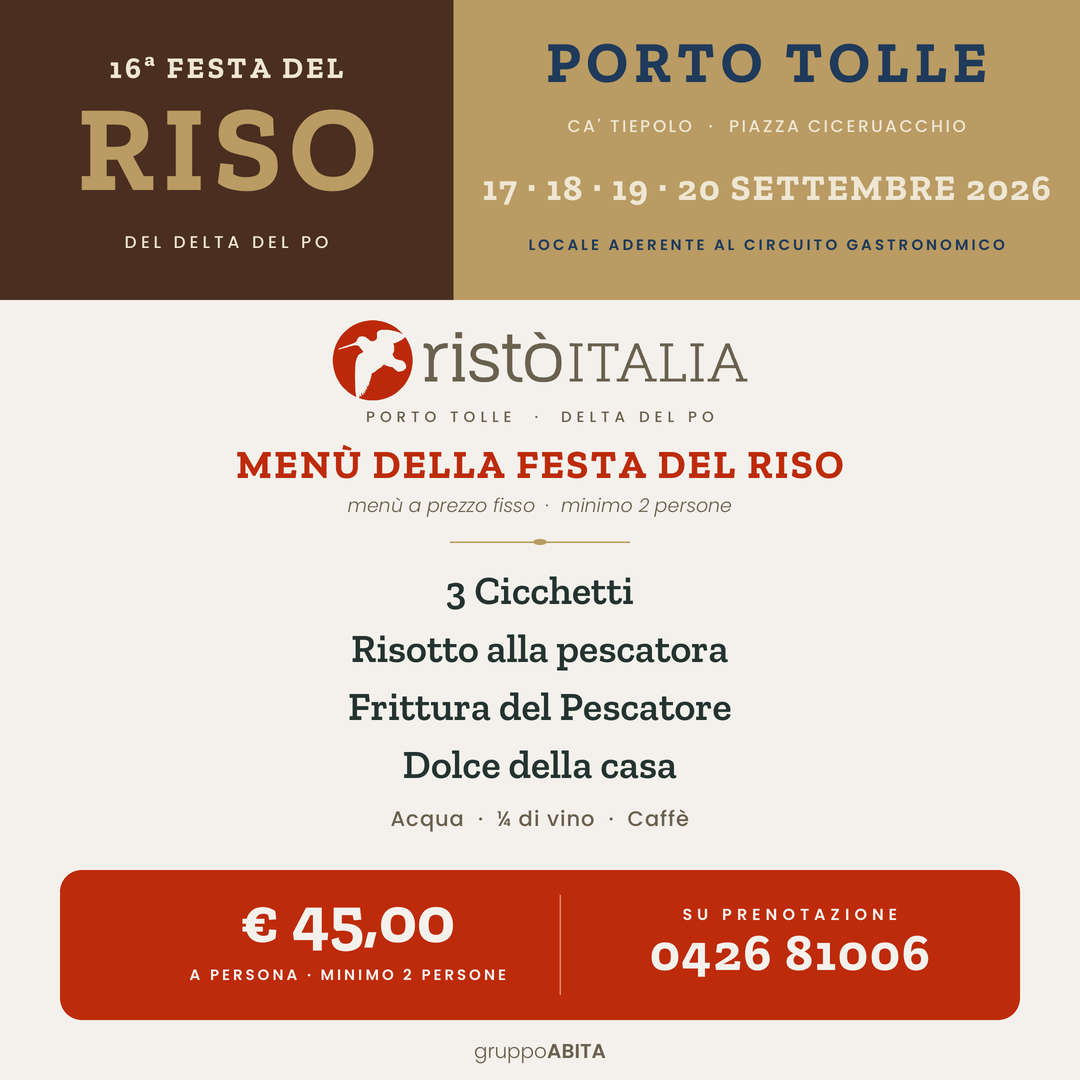
From 17 to 20 September 2026, in Porto Tolle, a set menu that brings together three Delta traditions: the Venetian cicchetto, the rice grown between the branches of the Po, and the fish from the Pila market. In the kitchen, Daniele Zizzi.
The sixteenth Rice Festival turns Ca' Tiepolo, the centre of Porto Tolle, into the capital of a grain that here is no ordinary product: it is the landscape itself. RistòItalia joins the festival's food trail with a menu designed to tell the Delta in four courses, without frills and without short cuts. Before sitting down, though, it is worth knowing where everything on the plate comes from.
The cicchetto: a Venetian invention five centuries old
We begin with three cicchetti, and that is no accident. The cicchetto is the oldest and most Venetian form of conviviality at table: it was born in the bàcari, the popular taverns of Venice, as a mouthful to accompany a glass of wine. Tradition traces it to the merchants of the Serenissima around the fifteenth century, when a concluded deal was celebrated with a piece of bread and something good on top: one of the world's first street foods, centuries before Spanish tapas became its better-known relative.
The word itself describes the portion: the most widely accepted theory derives it from the Latin ciccus, "a small quantity". The bàcaro, in turn, takes its name either from Bacchus, god of wine, or from the Venetian expression far bàcara, to celebrate. Meatballs, half a boiled egg, creamed salt cod, sardines in saor, baby octopus, a piece of polenta topped with the catch of the day: the cicchetto has always been the cooking of the sea and the lagoon in mouthful form. In 2025 the word formally entered the dictionaries of the Italian language, recognition of a culture that is still very much alive.
In the Delta the cicchetto is as much at home as in Venice, because the ingredients are the same and in many cases they set out from right here. At RistòItalia the three cicchetti on the menu change with what arrives from the market and the kitchen garden: they are Daniele Zizzi's way of saying welcome, before the first course even appears.
Carnaroli rice from the Delta meets the flavours of the sea
The heart of the menu is the risotto alla pescatora, the fisherman's risotto, and the heart of the risotto is the rice. Carnaroli is the variety chefs call the king of risotto rices: a large grain, rich in starch, able to absorb stock while holding its shape and to release just the right creaminess as it is finished. In the Po Delta it has found its chosen ground: the alluvial soils between Porto Tolle, Porto Viro, Taglio di Po and Ariano, formed by the river's deposits and reclaimed over the centuries, are naturally rich in minerals and potassium, and the nearby sea gives the grain a flavour found nowhere else. It is no surprise that Carnaroli is among the varieties recognised by the Protected Geographical Indication "Riso del Delta del Po".
On that grain Daniele builds his seafood sauce: a slow base of shellfish and molluscs, the merest hint of tomato, and whatever the season brings from the boats. The risotto is finished to order, with the timing Carnaroli allows without ever breaking down: al dente, creamy, the sea already there before the plate reaches the table.
"Here the rice and the fish grow in the same water. Putting them together on one plate is the most natural thing there is." — Daniele Zizzi
Fresh paranza from the Pila fish market
The main course is the frittura del pescatore, the fisherman's fry, and in Porto Tolle the phrase has a precise address: the fish market at Pila, a few kilometres from the restaurant, where the Delta boats land the catch of the coast and the lagoons every day. Paranza is, by definition, the small fish of the net: red mullet, anchovies, baby squid, prawns, whatever the sea has decided that day. Which is exactly why no two fries are ever the same.
Freshness and lightness make all the difference: fish landed that day, the thinnest coating of flour, clean oil at the right temperature, served at once. Alongside it, vegetables from the RistòItalia kitchen garden, which follow the same principle as the fish: pick what is ready and cook it the same day.
The house dessert and the drinks
The meal closes with the house dessert, made in our own kitchen, and with water, a quarter litre of wine and coffee included in the price. A complete, coherent menu, in which every course speaks of the place where it is served.
Why not to miss it
Because it is a menu that could not be repeated anywhere else: the cicchetto is Venetian, the Carnaroli is from the Delta, the paranza is from Pila, the vegetables come from the garden behind the house. Over the four days of the festival, between the streets of Ca' Tiepolo and the rice fields that surround the village, RistòItalia is the place to sit down and understand, one mouthful at a time, what eating in the Po Delta means.